Corona as catalyst: Social competition

Five centuries of Western dominance are now giving way to a new world order. Political, economic, military, cultural, and ideological structures are already being reshuffled. If the coronavirus spreads far enough, it will merely accelerate this transition. In this essay, I aim to briefly outline three of the major intersections shaping our time. Part 3: Social competition / Part 1. Ideological / Part 2. ‘Glocal’

The third question demanding attention in this time of transition—and even more so during the coronavirus pandemic—is the stark inequality in vulnerability within societies. I do not mean the increased vulnerability of the elderly, but the vulnerability of those lacking opportunities and security.

In recent years, many have highlighted growing inequality, particularly in so-called ‘undercover oligarchies’ such as China, Russia, India, Brazil, and the United States. Europe, Canada, and Australia fare somewhat better, thanks to more extensive welfare systems, stronger social dialogue, and progressive tax policies. Yet even in these regions, vulnerability is rising, as people find themselves unable to escape inadequate circumstances or overcome structural barriers that deny them the opportunity to thrive.

Consider the growing number of self-employed and gig workers, struggling with temporary contracts, low incomes, minimal social protection, and little political voice. In 2011, Guy Standing described this group as the “precariat” in The Precariat: The New Dangerous Class—a term combining ‘precarious’ and ‘proletariat.’ Standing warns that chronic vulnerability leaves people susceptible to populism and extremism.

Daniel Markovits, in The Meritocracy Trap (2019), examines how a segment of American society that initially benefited from meritocracy has now become a closed elite. From a young age, this group prepares for top positions, commanding top salaries and responsibilities, while the precariat struggles to keep up and remains trapped in insecure, low-status work. Markovits illustrates this through Uber: a small group of privileged managers and designers at the top, and millions of underpaid, overworked drivers at the bottom, with little hope of advancement.

Even in Europe, Australia, and Canada, social mobility is declining, leaving many only one accident away from financial disaster. And we are only beginning to grasp how automation, robotics, and digitalization will disrupt labor markets in the years ahead. The question gains urgency: how can we prevent social unrest fueled by structural inequality?

Now consider the pandemic in this context of social competition. One silver lining is that we have suddenly noticed those previously overlooked—the essential workers whose labor keeps society running. At the same time, the world faces a solidarity test of unprecedented scale.

The social and economic toll of lockdowns is immense. For millions of small business owners, losing a livelihood means losing a life’s dream, accompanied by sleepless nights over layoffs. For 60% of U.S. citizens, unemployment also means losing health insurance. Factory workers face hardship when global trade stalls. Labor migrants lose income abroad and, with it, the ability to support families at home. Day laborers risk a day without work, a day without food.

As the dust of the pandemic settles, one fact is already clear: those who have nothing to lose are vulnerable to extreme solutions—communist revolutions, ethnic cleansing, fascist nationalism, scapegoating, and sectarian violence. History has shown this before, and these threats remain real.

Anger is fueled by a lack of recognition. In times of uncertainty, we cannot afford for people to feel humiliated economically or socially. To prevent such anger, we must urgently ask: how can we safeguard each person’s self-esteem and dignity?

This raises a further question: what matters more to society—someone’s income or their contribution to its functioning? As long as income dominates our valuation, society remains divided into ‘workers’ and ‘volunteers,’ with the latter feeling undervalued. If, instead, we recognize all contributions to the common good—whether a police officer, accountant, nurse, family caregiver, church elder, or babysitting grandparent—we create a culture of genuine appreciation.

Recognizing unpaid work may require calculating its economic value—for example, the costs saved in healthcare by family caregivers. The next step is deciding how much value to assign to various contributions and how to ensure all efforts are appropriately recognized, including financially.

Hopefully, the pandemic encourages us to shift our admiration away from CEOs and traders toward the silent, often forgotten roles that keep society functioning. With unemployment soaring and the most vulnerable suffering the most, we cannot lose sight of everyone’s potential contributions. People need more than charity—they need to feel needed. Solidarity must take the form of acknowledgment and inclusion of every individual’s skills and efforts.

These are not optional exercises. The solidarity test is, in many cases, a matter of preventing anger. What applies within societies applies internationally: how do we prevent entire nations from having nothing to lose and becoming prone to extreme solutions?

The answer requires a global vision. It is time to rise above the four-year election cycle and consider what we want our nations and the world to look like in 2030, 2040, and 2050—and what investments are needed today. Climate change already demands this long-term perspective, but many other issues require the same approach. As Jeffrey Sachs writes in Common Wealth (2008): “The defining challenge of the 21st century will be to face the reality that humanity shares a common fate on a crowded planet.” That is our reality. Time is short. The pandemic is accelerating trends that were already in motion.

Part 1. Ideological / Part 2. ‘Glocal’ / BACK TO BLOGS

Corona as catalyst: ‘Glocal’ competition

Five centuries of Western dominance are now giving way to a new world order. Political, economic, military, cultural, and ideological structures are already being reshuffled. If the coronavirus spreads far enough, it will merely accelerate this transition. In this essay, I aim to briefly outline three of the major intersections shaping our time. Part 2: ‘Glocal’ competition / Part 1. Ideological / Part 3. Social

The world is in transition, first of all demanding ideological reflection within societies. But let us now consider this transition from an international perspective, because a second issue—already pressing—is becoming even more urgent: how important is national self-determination in a world that is increasingly interconnected and facing threats that demand international coordination?

Globalization is not new. For as long as we can remember, people have ventured ever farther from home in search of opportunity. History records a succession of winners and losers: those who benefit from other nations, and those who do not. Winners embrace the free movement of people, goods, and services; losers prefer to shut their borders. In past centuries, the West largely belonged to the winning side, asserting its right to free trade—even when selling, for example, opium to China. Today, we see the Chinese, Indians, Poles, and Mexicans seizing the opportunities of free movement, while the wealthiest parts of the West respond with slogans such as “America First” (Trump), “We Want Our Country Back” (UKIP), and “The Netherlands Is Ours” (Party for Freedom).

Behind this nostalgic nationalism and ironic protectionism lies a double motive: the West’s perceived loss of control threatens people not only economically but culturally. Chinese and Russian investors acquire Western companies and football clubs; Western mosques and Islamic schools are funded with Turkish and Arab money. Add the fear of Europe’s “Islamification,” and, in the Netherlands, the heated debate over Black Pete, and for many it is clear: it is not only Western economies but also Western culture that must be fiercely defended.

At the same time, something unprecedented is happening: never before has the entire world needed to collaborate to safeguard the planet. All nations face the same threats—climate change, nuclear risks, scarcity of water and raw materials, cyberattacks, refugee flows, human trafficking, and more. Each of these issues requires international coordination to be addressed effectively. No hacker, tsunami, or radioactive leak respects national borders, trade balances, or cultural heritage. In all these cases, nationalism alone is doomed to fail.

Now consider the pandemic unfolding amid this “glocal” competition. Here is another global challenge that binds nations together precisely as nationalism surges. Which way will the balance tip: toward international collaboration or national self-sufficiency? At present, we see both: countries confronting the same virus as if the rest of the world—or even the EU—did not exist, while scientists collaborate across continents to develop a vaccine.

This duality highlights an essential fact—one that shaped Europe’s history but is often forgotten in nationalist times: science and technology are never purely local affairs; they determine the fate of all humankind. Countries that isolate their scientific knowledge may protect a patent or two, but they forfeit the global potential of brainpower, expertise, and innovation.

And what of the economy? Will the pandemic push nations apart or bring them closer? History offers a lesson. During World War I, the sudden halt of global trade exposed nations’ vulnerabilities. Food shortages led to crises—including a national revolt in the Netherlands. After the war, many countries sought economic self-sufficiency (autarky). This strategy, however, created winners and losers. Some nations managed far better than others, and after a few decades, three proud nations—trapped by their own autarky policies and convinced of their entitlement—sparked World War II.

Today, we again witness the vulnerabilities of a globalized world: first physical, then economic. Disruptions in global trade are causing shortages, tempting politicians—especially in the West—to advocate economic self-sufficiency. In some cases, this makes sense: securing medical supplies, medicines, or reducing CO₂ emissions. But new self-sufficiency inevitably creates winners and losers. Famines and civil wars may follow when countries close their factories, and even less dramatic effects—for instance, reduced exports—can ripple outward.

This raises another question: when is it appropriate for a nation to defend its self-interest, and when does such defense backfire because cooperation and good relationships with other nations are essential?

The West is losing influence in the world. The United States and Great Britain, in particular, suffer from a “post-imperial stress disorder.” The world no longer aligns so neatly with Western interests, and some politicians interpret this as a license for unfettered national self-protection. The coronavirus may intensify this tendency, but the more inward-looking the West becomes, the more China—and soon India—will fill the leadership vacuum. Not only do these nations benefit from international partnerships, but many global challenges still demand cooperation. Countries can only achieve their goals if they can mobilize allies when decisions are made. China understands this and continues investing in relationships—even during the pandemic—while the West often weakens its old alliances.

The pandemic has made one reality undeniable: all nations share a single fate on one planet. As Westerners, we once held noble ideas about global responsibility. Let us hope we do not long forget why liberty, equality, and fraternity were cherished—not for one privileged nation, but for all of humankind.

Part 1. Ideological / Part 3. Social / BACK TO BLOGS

Corona as catalyst: Ideological competition

Five centuries of Western dominance are now giving way to a new world order. Political, economic, military, cultural, and ideological structures are already being reshuffled. If the coronavirus spreads far enough, it will merely accelerate this transition. In this essay, I aim to briefly outline three of the major intersections shaping our time. Part 1: Ideological competition / Part 2. ‘Glocal’ / Part 3. Social

Since 2006, Freedom House has reported a decline in freedom and democracy worldwide—that is, freedom and democracy as Westerners understand it. China plays a major legitimizing role in this trend. With its collectivist and paternalistic regime, it challenges the ideological benchmark of the West. No matter how much privacy, journalistic independence, or political participation is curtailed in Chinese society, no Western country is willing to pay the price of a direct confrontation. Too costly, too risky. Some banks are too big to fail; some countries are too big to franchise. A giant like China cannot be reshaped in the West’s image, and under Xi Jinping, it has abandoned any hesitation. China openly emphasizes the non-universal nature of Western democracy, and the West exposes its impotence by remaining silent.

At the same time, the failures of the “global democratic revolution” announced by Bush during the 2003 Iraq War, the continuous arms supplies from the ‘free world’ to autocratic regimes, and the exposure of Western hyper-liberalism during the financial crisis are all evident. And one group is keenly watching: the authoritarian leaders of the world. They interpret these developments as confirmation of their own ambitions.

Loss of economic power leads inevitably to a loss of ideological influence. Gradually, we are realizing the implications for the emerging world order. The “Xi Jinping Thought on Socialism with Chinese Characteristics for a New Era” has become an alternative ideology alongside Western political thought. Every country is now forced to take a position. Neutrality is no longer an option. Each nation will occupy a place on a spectrum between Western individualism and Eastern collectivism, between American liberalism and Chinese socialism.

Even the West is beginning to feel drawn toward Eastern thinking. According to the OECD, by 2030, 60% of middle-class consumption will take place in Asia. Global products—movies, for example—will increasingly be tailored to Eastern cultural tastes. The West will not remain unaffected. And this is only the beginning of India’s rise. The more India asserts its independence from the US, the more its cultural and ideological influence will expand.

Now consider the pandemic amid this ideological competition. What captures our attention as we fight the virus: individual or collective interest? And which approach proves more effective: the individualistic West or the collectivist East? For authoritarian regimes, the crisis only reinforces confidence. The coronavirus has provided a perfect justification for submitting China’s 1.4 billion citizens even more fully to an omnipresent surveillance system.

The West, meanwhile, has suspended a dramatic range of freedoms to combat the virus. Citizens largely approve, trusting the measures are temporary. But how temporary is “temporary” if pandemics recur, and other dangers—climate change, cyber-attacks, nuclear risks, global terrorism—remain just as menacing? All these threats demand collective responses. Should we really restore all freedoms? Would it not be wise to adopt at least some of the digital technologies proving effective in Asia?

The coronavirus has intensified a question that has been pressing since China’s rise: how to strike the right balance between individual and collective interests, liberty and security. I expect Western countries to drift toward Eastern thinking. How far they move will depend on how convincingly they can articulate the value of individual liberty—and the responsibility it entails. Liberty requires less control, and less control entails risks. The more insecure our lives become, the greater our faith in freedom must be if we are not to surrender it in the name of security.

Part 2. ‘Glocal’ / Part 3. Social / BACK TO BLOGS

Corona reveals the world’s peculiarities

A ghost is haunting the world – a virus that enters all nations into a holy alliance. Yet, no matter how much we fight the same enemy, our battle is as colorful as the nations. Whoever wishes to get to know the world can learn a lot these days. In response to the same virus all countries and leaders reveal their own peculiarities. Let me mention a few.

National personalities

  • In egalitarian countries, leaders are quick in calling upon their citizen’s responsible; in hierarchic countries, citizens are quick in holding their leaders responsible.
  • In democratic countries, leaders are checked for accuracy and honesty; in authoritarian countries, leaders tend to avoid criticism through concealment.
  • In more ‘reason oriented’ countries, leaders tend to consider a targeted lockdown to spare the economy and build immunity; in more ‘passion oriented’ countries, leaders tend to reject this as cold and calculated and advocate for a total lockdown.

International reflexes

  • In the United States, we hear Trump speak of the “Chinese virus”; in Russia, we hear people speak of an American bioweapon.
  • In Africa, people suspect the West of using Africans as guinea pigs in the development of a vaccine.
  • In the European Union, old accusations between north and south come to light as soon as financial support is discussed.

Ideological priorities

  • While the US president makes every effort to protect the economy (leading to measures that are long overdue), the Chinese president makes every effort to secure the well-being of its citizens (leading to an even greater state control).
  • While the one European leader calls upon everyone’s sense of public responsibility, the other seizes the moment to rule by decree.

Seen in this light, this corona time is not exactly a revolutionary time. Rather, it is one big affirmation of the status quo. Still, many people state that the world will not be the same after corona. Are they right? I think they are. But let’s not forget that the world was changing already and will change anyway. In the next blogs I will explain why.

BACK TO BLOGS

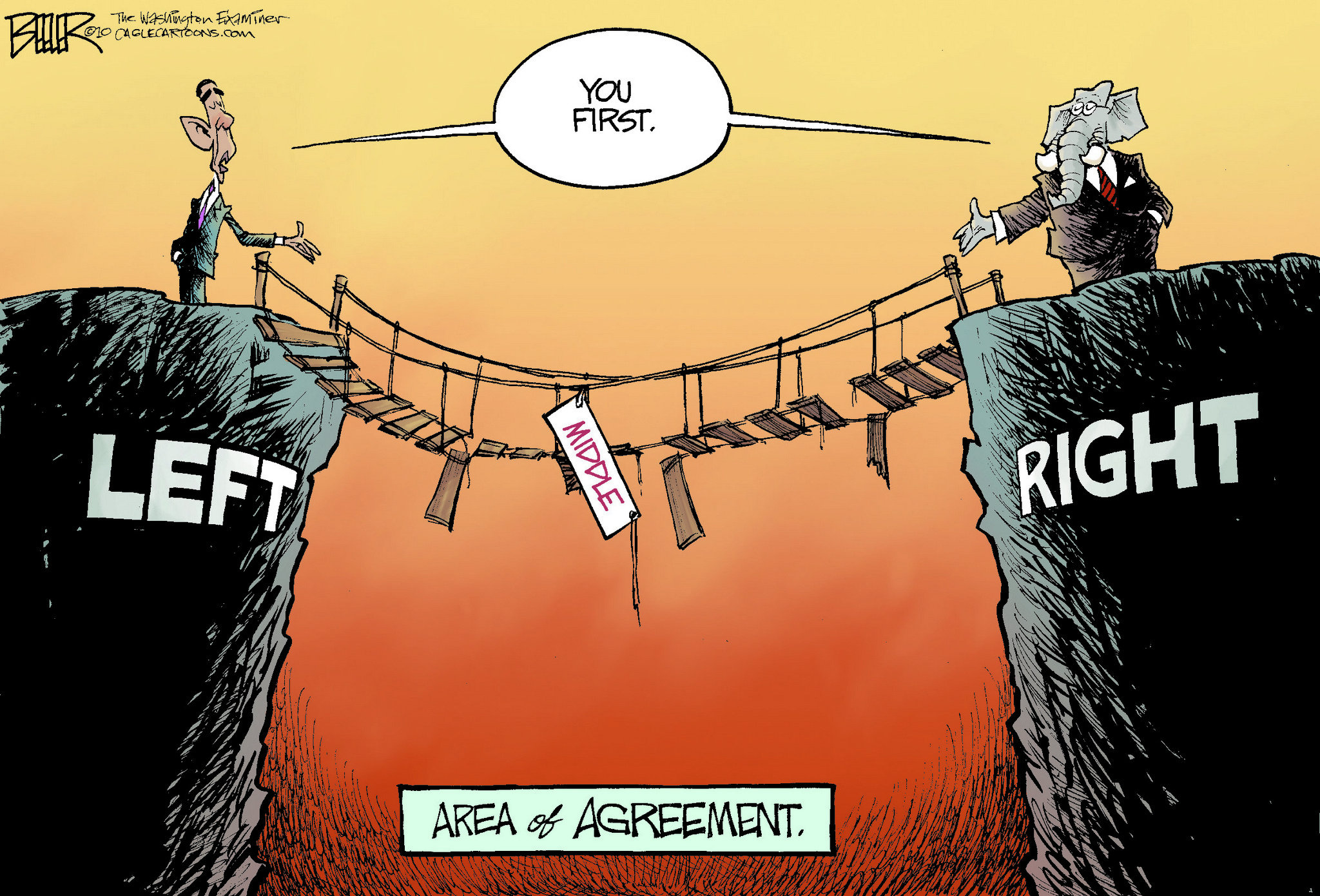
Pleasing and uniting Left and Right

The growing gap between Left and Right in politics is plain for all to see. It provoked the following thoughts , with a special focus on western societies. Don’t take them too seriously, or too lightly.

If you want to please the Right, tell them that:

  • climate change isn’t man-made,
    and it will save them reconsidering their life style;
  • migrants undermine our job security,
    and it will save them expressing some solidarity;
  • Islam is a threat to society,
    and it will save them investing in appreciating Muslim citizens;
  • the West needs protection from the rest,
    and it will save them fixing its flaws.

If you want to please the Left, tell them that:

  • capitalism is evil,
    and they will feel good about consuming without a peace of mind;
  • we are facing catastrophe,
    and it will give them a purpose in life that makes them thrive;
  • we need to stand up for the poor and oppressed,
    and they will ignore any progress to not ruin their anger;
  • it’s all about speaking against injustice,
    and they will love their own clarity of right and wrong.

In short:
Want to please the Right? Ease their conscience.
Want to please the Left? Stir their conscience.

False clarity

  • The Right sees in any Muslim a potential terrorist, in any migrant a potential criminal, in any call for tolerance or equality a conspiracy of Cultural Marxists.
  • The Left sees in any Muslim a victim of Islamophobia, in any migrant a victim of oppression, in any free market defense an exploitation of the weak.
  • In short: the Right sees too many perpetrators, the Left too many victims. It gives the Right a continuous right to protect, the Left a continuous right to accuse.

Both wings cannot stand the temptation of making the world look clearer than it is. For the Right, everything looks like a threat that requires self-defense. For the Left, everything looks like injustice that requires solidarity with the oppressed. The latter sounds more noble than the first, and so the Left doesn’t hesitate taking the moral high ground in debates. The Right, on the other hand, accuses the ‘multicultural’ and ‘egalitarian’ Left of destroying ‘Western’ (if not ‘Christian’) values and traditions. And so, Left and Right feel morally empowered to fight each other in a never-ending trench war.

How to combine the positives in both

Without pretending that this trench war can be ended easily, here are a couple of ways in which Left and Right can move towards more unity:

  • The Left needs a deeper recognition of western achievements, if it wants to connect with the protecting attitude of the Right.
  • The Right needs a deeper recognition of western flaws, if it wants to connect with the correcting attitude of the Left.
  • The Left needs more celebration and self-criticism. It is so obsessed with fighting injustice, that there is hardly space for celebrating past achievements and recognizing the limitations of their own understanding.
  • The Right needs more compassion and solidarity. It is so obsessed with self-protection, that there is hardly space for seeking the well-being of other nations and the entire planet.

Sounds all good ‘on paper’, these recipes for unity, but profound mentality shifts are usually not a matter of the will but of necessity, of circumstances that demand a radically different response. Let’s hope that Left and Right will read the ‘signs of the times’ in time and need only ‘mild’ circumstances to acknowledge the necessity of overcoming their differences and pursuing a united and sustainable way forward.

BACK TO BLOGS

ABC Radio Interview: faith versus fear

Interview by Meredith Lake (ABC Radio, Australia) with Tim Costello and myself about the role of faith in our own lives and in today’s world. Yes, public radio. Times are changing when it comes to talking faith in secular societies. Hope you enjoy (despite my English). It was a great pleasure and privilege doing this with Tim. Recorded on 19 March 2019. Click here for more information on the website of ABC Radio.

BACK TO BLOGS

Three unavoidables if the West wants to sustain itself in a rapidly changing world

Speech I recently gave for the Koninklijke Industrieele Groote Club (www.igc.nl) in Amsterdam.

Brexit, Border Wall, Catalan separatism — western countries are absorbed by their own sovereignty issues. As a consequence, a much bigger issue is not addressed: how to sustain the West itself? Precisely when the West as a whole is losing influence, it is trapped in internal division. Instead of reflecting on a future-proof and non-imperialistic role for the West, (too many) western politicians are wasting precious time fighting each other and bullying the rest. The result is that they catalyze precisely the kind of marginalization they try to stop.

On 2 February 2019 I wrote that if the GDP projections of PwC are correct, not a single European country will sit at the table when the G8 gathers in 2050. Yet precisely now, nationalism is thriving and entire nations manage to grossly overestimate themselves.

As a Dutchman I live in the midst of this turmoil. At the same time, I crossed the globe in the last 10 years, speaking with social actors on all continents about sustainable solutions for social issues. Based on this experience, below 3 urgent recommendations to western politicians if they want the West to play a viable role in the years to come.

I. Stop being in denial

  1. Stop disguising the present
    • In this critical time of shaping our planetary future, facing major threats like cyber crime, nuclear risks, pandemics, global terrorism and climate change, the West cannot afford misleading politics: presenting ‘alternative facts‘ for electoral gain, hiding costs and difficulties when promoting solutions, and creating a false dichotomy between nationalism and globalism.
  2. Stop idealizing the past
    • As the West needs to respond to new issues (like its loss of power and the need for global solutions to global issues), it cannot afford a nostalgia that makes people only yearn for times that won’t come back. Above all, western countries need to overcome their post-imperial stress syndrome in which they only weaken their position by behaving as if they are still calling the shots. Brexit is currently the most dramatic example of this. It painfully shows that the United Kingdom is in no position to negotiate with 27 nations on an equal footing. Ironically, only a supranational entity like the EU can make this kind of equal dialogue possible. Leaving the EU means: falling back on the old law of the strongest between nations. Separatists in Scotland and Catalonia will bump into the same reality if they ever face negotiations with the UK or Spain.
  3. Stop blocking the future
    • Reform is gravely needed to make international institutions more suitable for global dialogue and collaboration. The longer the West waits with giving up its disproportionate power in the UN Security Council, World Bank, IMF, etc., the bigger the chance that non-western nations create their own entities (like China’s Asian Infrastructure Investment Bank). This weakens not only the western-controlled entities, but also the world’s ability to solve its joint issues.

II. Secure your Western values

  1. Secure your activism
    • 400 years ago, the West started embracing a mentality of not accepting human suffering, but always seeking “to relieve and benefit the condition of man” (Francis Bacon, 1620). This mentality is inherently optimistic, as it persistently believes that it is worth seeking solutions for whatever challenge we face. The current doom and gloom attitude of the West threatens this spirit. Time to breathe new life into it and make the whole world benefit.
  2. Secure your democracy
    • 200 years ago, the West started embracing the idea that every human being deserves equal respect and equal opportunity to participate in civil and political life without discrimination or repression. This idea is currently under pressure, with politicians disqualifying entire groups in society based on religion or ethnic background, with income inequality rising again, freedom in decline worldwide, and even EU countries leaning towards authoritarian types of governance. Time to re-affirm the meaning of universal human dignity.
  3. Secure your solidarity
    • 100 years ago, the West started embracing a welfare system in which the state protects and promotes the economic and social well-being of its citizens. After World War II, this system got expanded in Western Europe in response to Fascism, Nazism and Communism. It had become painfully clear that people who have nothing to lose become prone to extreme politics. In this time of new uncertainty and discontent, the West can draw from its past a powerful incentive to invest in solidarity again. Globalization, automation and robotics will disturb the labor market to such an extent, that a growing group of unemployed people cannot be retrained in time and stay unemployed. It will be up to us to decide, whether we want to further humiliate these citizens by treating them as a ‘cost item’ to society, or invite them to show their value in other ways.

III. Start valuing your assets

  1. Value your allies
    • If China can openly reject western democracy, Russia openly annex Crimea, and Turkey openly censor the media, western countries better start valuing their like-minded allies. This is the worst moment for the West to be internally divided, as it directly undermines the strength and credibility of western ideology. Building and preserving western partnerships, even at the cost of national sovereignty, may be the only way for the West to keep the critical mass that it needs to sustain what it holds dear.
  2. Value your culture
    • In 2030, Asia will represent 66% of the global middle-class population and 59% of middle-class consumption. Economic power means cultural power: the world will see more eastern-oriented products, adapted to the preferences of the biggest market: Asia. The West will have to decide where it draws the line in adapting to this culture shift. Not for superiority reasons, but to maintain a western sense of home and preserve the cultural assets with which the West can complement other nations.
  3. Value your planet
    • All of the above becomes irrelevant if the West cannot preserve the biggest asset it shares with all nations: our one world, with its global issues and vulnerable ecosystems. Before sustaining itself, the West needs a plan for the planet, for “there is no planet B”. The planet does not care about East or West, North or South. It only feels the weight of 7 billion people and eagerly awaits the moment in which all unite around one vision for the one earth we have.

In short, we urgently need western politicians who don’t give in to polarized debates but boldly manage to do both: preserving our assets with western nations as our contribution to the common good and our sense of home in the world, and preserving our planet with all nations to have a home at all.

BACK TO BLOGS

Technologies that can make this world a better place – part 2: reforestation 2.0

Promising new technologies can suddenly make the future look a lot less gloomy. Today part 2: reforesting the world’s most barren lands by nurturing “the underground forest” and allowing it to heal itself.

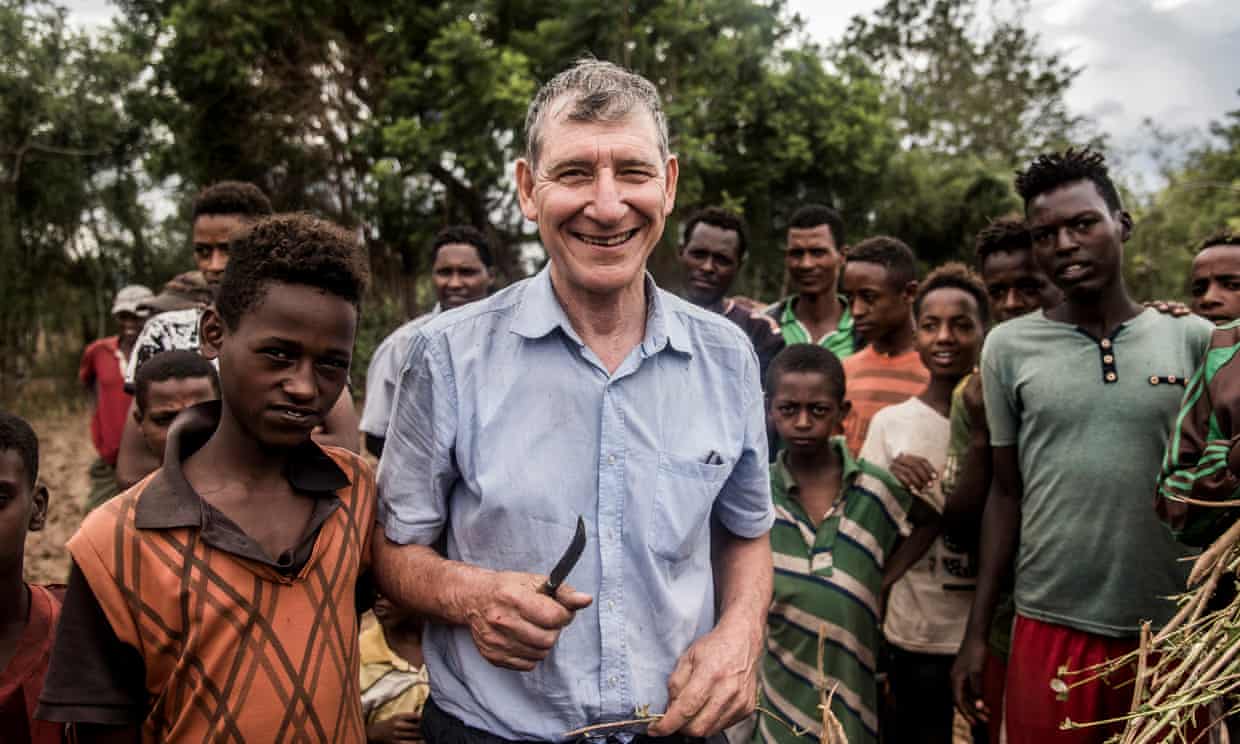
Tony Rinaudo (courtesy of Silas Koch/World Vision)

Meet Tony Rinaudo, also known as the Forest Maker or Tree Whisperer, one of the very few people on earth whose achievements can be seen on satellite images. This man is responsible for regenerating no less than 240 million trees in the last 30 years.

In 1983, after two years of doing reforestation ‘the old way’ in Niger, namely by planting trees, Rinaudo despaired:

I was in charge of a reforestation project that was failing miserably, it wasn’t that I was particularly dumb, it was the same story all over west Africa. And I remember the frustration that just hit me: north, south, east, west, was a barren landscape, and I knew perfectly well that 80 or 90% of the trees I was carrying [in my car] for planting would die.

But then Rinaudo took a closer look at the few bushes scattered around the land. He knew these bushes were in fact trees that had been hacked down. Suddenly he wondered: what if we would prune these left-over trees and allow them to grow?

In that moment, everything changed. We didn’t need to plant trees, it wasn’t a question of having a multi-million dollar budget and years to do it, everything you needed was in the ground.

Rinaudo had found an “embarrassingly simple solution” to a seemingly insurmountable problem. The root system of the chopped down trees remained alive under the ground; a whole “underground forest” was still available, as Rinaudo would describe it. The only thing needed was some human care and protection, allowing the trees to grow and heal themselves. In Rinaudo’s words: the only thing needed was some humans “working with nature rather than hitting it on the head all the time.”

After his discovery, Rinaudo had to overturn generations of accepted wisdom, as well as a resistance to giving some land back to nature.

When you’ve got people who are on the edge of starvation every year, not just in famine years, you’ve got this perception that you need every square inch of farmland to grow food crops. And here’s this nut telling people they should sacrifice some of their land for trees.

But as soon as farmers started to see the results of Rinaudo’s method (called Farmer-Managed Natural Regeneration, or FMNR), the new technique took off. And here we are: 3 decades later and 240 million trees richer. At the UN’s global climate talks in Katowice (December 2018), Rinaudo explained the profound impact of these trees. They:

  • improve farming yields
  • reduce ground temperatures
  • hold water in the soil
  • provide firewood
  • make farming in hot places more comfortable
  • and last but not least: all these trees act as a powerful carbon sink, with the potential to draw in billions more tonnes of carbon

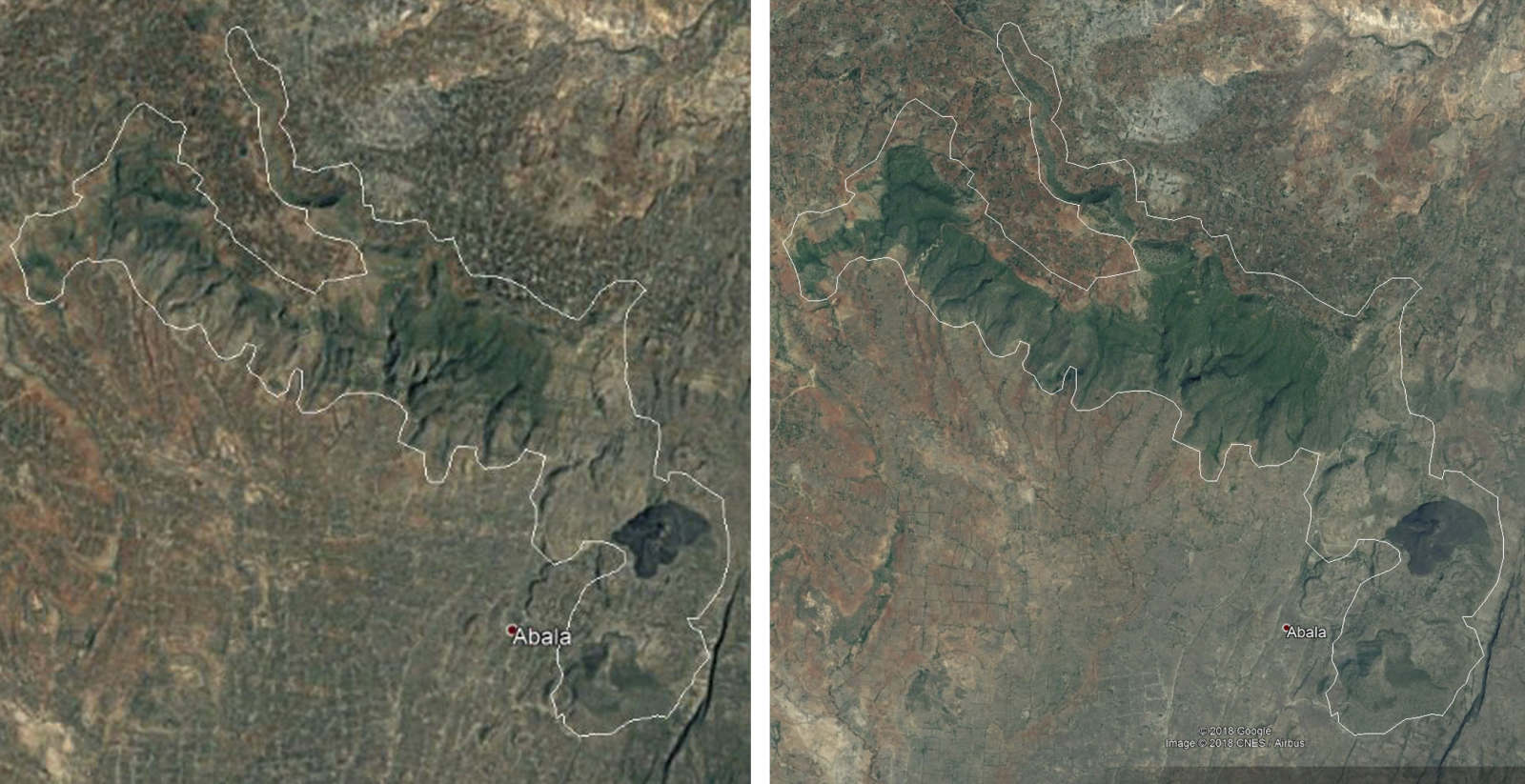
A satellite image of the Humbo region of Ethiopia, showing tree cover in 2005 (left) and in 2017 (right). (Courtesy of World Vision)

Working with World Vision since 1999, Rinaudo has taken his technique across the world, from arid Somaliland to tropical East Timor. His big dream: to see FMNR introduced into at least 100 countries by 2030, as a powerful way of improving people’s lives and pursuing Sustainable Development Goal #15.

In September 2018, Rinaudo received the Right Livelihood Awards, often described as the Alternative Nobel Price. Rinaudo received the award “for demonstrating on a large scale how drylands can be greened at minimal cost, improving the livelihoods of millions of people. [Rinaudo’s reforestation method] has the potential to restore currently degraded drylands with an area the combined size of India.”

Below a video about Rinaudo’s work and impact, produced by World Vision. Much more information can be found on the FMNR website.

BACK TO BLOGS

Technologies that can make this world a better place – part 1: desalination 2.0

Promising new technologies can suddenly make the future look a lot less gloomy. Today part 1: turning salt water into sweet water in a way that is not only affordable to countries like the US and Saudi-Arabia.

Today, 2.1 billion people lack safe drinking water at home, a figure that is expected to increase. (UN) Our water use is growing twice as fast as our population growth. More and more regions are reaching the limit of being able to deliver sustainable water services. If nothing changes, the projection is that by 2050 at least 1 in 4 people will be affected by recurring water shortages. (UN)

For this reason, 193 countries committed in 2015 to Sustainable Development Goal #6: access to safe water and sanitation for all by 2030. Not an easy goal to pursue. The world is facing severe water challenges: more droughts, melting ice caps, pollution, lack of water infrastructure, growing bio-energy demands, growing meat demands, and endangered ecosystems.

But here is an intriguing fact: most countries have a coast line and therefore direct access to plenty of salt water. Shouldn’t we consider desalination (turning salt water into sweet water) one of the most obvious solutions to the scarcity issue? Yes, we should. And as a matter of fact, there are already over 18,000 water desalination plants operating in 150 countries, producing water for 300 million people. (PNAS, 2017)

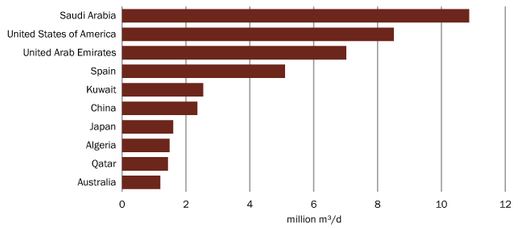
Desalination plants, however, cost a lot of money (up to 1 billion USD) and require a lot of energy: producing a 1000 liter of drinking water takes as much energy as the average Belgian consumes each day. Some countries, especially those with large oil reserves, can cope with these demands (50% of Saudi-Arabia’s drinking water comes from desalination). For other countries it is soon too much. Most of the desalination plants are therefore only in a few countries (see below).

Distribution of desalination plants by country. Source: Nanalyze (2014)

To make desalination more affordable, researchers have been looking for ways to reduce the energy costs and make the process less dependent on expensive and immobile desalination plants. This has led to some promising innovations. In this blog I would like to highlight two of them:

  • A team of Rice University (Houston, US) managed to reduce energy costs by using low-cost, commercially available nanoparticles and sunlight in the desalination process. At the same time, they turned the process into a compact water solution for families and communities also at remote locations. (PNAS, 2017) In other words: no 1 billion USD plant needed. Professor Qilin Li : “We are creating off-grid systems to provide water anywhere it’s needed.” The video below explains.
  • Marjolein Vanoppen of Ghent University (Belgium) found a way to both generate energy and lower the amount of energy needed to produce drinking water. How: by benefiting from the fact that when salt and fresh water come together, the salt moves towards the fresh water, a movement that generates energy. In Vanoppen’s solution, energy is first generated by allowing salt to move from salt water to waste water (not suitable for drinking water production). The generated energy is then used to further desalinate the salt water until it is drinkable. In the video below, Vanoppen explains (from 49:03).

Promising innovations like these require further research and investment funds for scalable applications. A perfect opportunity for governments and entrepreneurs to demonstrate the visionary leadership this world so profoundly needs.

BACK TO BLOGS

The irresistible features of Western populism

What characterizes Western populism ? Matthew Goodwin, professor of politics at the University of Kent, gives the following answer:

In the aggregate, national populists oppose or reject liberal globalisation, mass immigration and the consensus politics of recent times. They promise instead to give voice to those who feel that they have been neglected, if not held in contempt, by increasingly distant elites.

Given the rise of populism in the West, what is so attractive about this opposition to liberal globalization, mass immigration and consensus politics? Some very basic human needs. And although one would expect every politician to address these needs, populists somehow manage to be more convincing to a growing group of people. Here they are:

  1. Populists tackle people’s cultural need to come home somewhere.
    • Populists show that they realize that unlimited globalization leads to homelessness. A world that only facilitates free movements of people and ideas across the globe, makes people feel lost in their own country, city or street. ‘The world’ is too big and too diverse to provide a local neighborhood that feels safe and familiar. To feel at home somewhere, we need to understand the language of our neighbors, appreciate a common set of customs and attitudes, and share some basic values and convictions. Without these, a society becomes socially disintegrated and culturally perplexed.
  2. Populists tackle people’s social need to be seen and economic need to be protected.
    • Populists show that they realize that people on the losing end of globalization, automation and robotics cannot keep hearing that these changes are unavoidable. They need politicians who can make them feel that they actually care about the ‘forgotten ones’ in society, and are willing to take an uncompromising stand in protecting their well-being.
  3. Populists tackle people’s political need for clarity and leadership.
    • Populists show that they realize that people who are not trained to deal with complex issues can feel more and more lost in a world that gets more and more complicated. This group is not waiting for academic reflections on the uncertainty and ambiguity of things, but for a clear description of both the problem and the solution, and robust leadership when it comes to pursuing this solution.

So, here is the good news about Western populism: it raises awareness of some basic human needs that are currently insufficiently addressed, forcing other politicians to respond as well. The solutions that populists promote, are, however, not without a price:

  1. Populists promote nationalism at the cost of global collaboration.
    • Protecting national cultures and economies won’t solve issues that still require international collaboration (cyber crime, nuclear risks, pandemics, international crime, global terrorism, climate change, etc.) It also won’t stop the dependency of countries on international trade. Somehow, the ‘art of the deal’ lies in combining all three: securing people’s cultural homes and securing international trade and securing the planet’s future. A juggle as difficult as it is unavoidable.
  2. Populists provoke disappointment by over-shouting themselves.
    • In their effort to respond to people’s need for clarity and leadership, it is tempting for populists to bring a lot of misery in society back to one enemy or cause. Build a wall, leave the EU, stop the immigrants, fight Islam, and most will be well. This simplicity won’t last. One day, reality will reveal the true complexity of things – and who will people then believe? Somehow, the ‘art of the deal’ lies in offering a clear vision to people who deal with uncertainties, a vision that secures people’s well-being and keeps everyone participating, but without hiding unavoidable costs and difficulties.

Here are 2 lessons for Western politics we can draw from the above:

  1. Don’t make people choose between nationalism or globalism, but invest in both a cultural home and collaboration across borders.
  2. Don’t make people choose between compelling simplicity or realistic complexity, but invest in the clarity and leadership that is required to keep everyone on board in a transitioning society.

This last point I will pick up in a later blog.

BACK TO BLOGS