Corona as catalyst: Social competition

Five centuries of Western dominance are now giving way to a new world order. Political, economic, military, cultural, and ideological structures are already being reshuffled. If the coronavirus spreads far enough, it will merely accelerate this transition. In this essay, I aim to briefly outline three of the major intersections shaping our time. Part 3: Social competition / Part 1. Ideological / Part 2. ‘Glocal’

The third question demanding attention in this time of transition—and even more so during the coronavirus pandemic—is the stark inequality in vulnerability within societies. I do not mean the increased vulnerability of the elderly, but the vulnerability of those lacking opportunities and security.

In recent years, many have highlighted growing inequality, particularly in so-called ‘undercover oligarchies’ such as China, Russia, India, Brazil, and the United States. Europe, Canada, and Australia fare somewhat better, thanks to more extensive welfare systems, stronger social dialogue, and progressive tax policies. Yet even in these regions, vulnerability is rising, as people find themselves unable to escape inadequate circumstances or overcome structural barriers that deny them the opportunity to thrive.

Consider the growing number of self-employed and gig workers, struggling with temporary contracts, low incomes, minimal social protection, and little political voice. In 2011, Guy Standing described this group as the “precariat” in The Precariat: The New Dangerous Class—a term combining ‘precarious’ and ‘proletariat.’ Standing warns that chronic vulnerability leaves people susceptible to populism and extremism.

Daniel Markovits, in The Meritocracy Trap (2019), examines how a segment of American society that initially benefited from meritocracy has now become a closed elite. From a young age, this group prepares for top positions, commanding top salaries and responsibilities, while the precariat struggles to keep up and remains trapped in insecure, low-status work. Markovits illustrates this through Uber: a small group of privileged managers and designers at the top, and millions of underpaid, overworked drivers at the bottom, with little hope of advancement.

Even in Europe, Australia, and Canada, social mobility is declining, leaving many only one accident away from financial disaster. And we are only beginning to grasp how automation, robotics, and digitalization will disrupt labor markets in the years ahead. The question gains urgency: how can we prevent social unrest fueled by structural inequality?

Now consider the pandemic in this context of social competition. One silver lining is that we have suddenly noticed those previously overlooked—the essential workers whose labor keeps society running. At the same time, the world faces a solidarity test of unprecedented scale.

The social and economic toll of lockdowns is immense. For millions of small business owners, losing a livelihood means losing a life’s dream, accompanied by sleepless nights over layoffs. For 60% of U.S. citizens, unemployment also means losing health insurance. Factory workers face hardship when global trade stalls. Labor migrants lose income abroad and, with it, the ability to support families at home. Day laborers risk a day without work, a day without food.

As the dust of the pandemic settles, one fact is already clear: those who have nothing to lose are vulnerable to extreme solutions—communist revolutions, ethnic cleansing, fascist nationalism, scapegoating, and sectarian violence. History has shown this before, and these threats remain real.

Anger is fueled by a lack of recognition. In times of uncertainty, we cannot afford for people to feel humiliated economically or socially. To prevent such anger, we must urgently ask: how can we safeguard each person’s self-esteem and dignity?

This raises a further question: what matters more to society—someone’s income or their contribution to its functioning? As long as income dominates our valuation, society remains divided into ‘workers’ and ‘volunteers,’ with the latter feeling undervalued. If, instead, we recognize all contributions to the common good—whether a police officer, accountant, nurse, family caregiver, church elder, or babysitting grandparent—we create a culture of genuine appreciation.

Recognizing unpaid work may require calculating its economic value—for example, the costs saved in healthcare by family caregivers. The next step is deciding how much value to assign to various contributions and how to ensure all efforts are appropriately recognized, including financially.

Hopefully, the pandemic encourages us to shift our admiration away from CEOs and traders toward the silent, often forgotten roles that keep society functioning. With unemployment soaring and the most vulnerable suffering the most, we cannot lose sight of everyone’s potential contributions. People need more than charity—they need to feel needed. Solidarity must take the form of acknowledgment and inclusion of every individual’s skills and efforts.

These are not optional exercises. The solidarity test is, in many cases, a matter of preventing anger. What applies within societies applies internationally: how do we prevent entire nations from having nothing to lose and becoming prone to extreme solutions?

The answer requires a global vision. It is time to rise above the four-year election cycle and consider what we want our nations and the world to look like in 2030, 2040, and 2050—and what investments are needed today. Climate change already demands this long-term perspective, but many other issues require the same approach. As Jeffrey Sachs writes in Common Wealth (2008): “The defining challenge of the 21st century will be to face the reality that humanity shares a common fate on a crowded planet.” That is our reality. Time is short. The pandemic is accelerating trends that were already in motion.

Part 1. Ideological / Part 2. ‘Glocal’ / BACK TO BLOGS

Corona as catalyst: ‘Glocal’ competition

Five centuries of Western dominance are now giving way to a new world order. Political, economic, military, cultural, and ideological structures are already being reshuffled. If the coronavirus spreads far enough, it will merely accelerate this transition. In this essay, I aim to briefly outline three of the major intersections shaping our time. Part 2: ‘Glocal’ competition / Part 1. Ideological / Part 3. Social

The world is in transition, first of all demanding ideological reflection within societies. But let us now consider this transition from an international perspective, because a second issue—already pressing—is becoming even more urgent: how important is national self-determination in a world that is increasingly interconnected and facing threats that demand international coordination?

Globalization is not new. For as long as we can remember, people have ventured ever farther from home in search of opportunity. History records a succession of winners and losers: those who benefit from other nations, and those who do not. Winners embrace the free movement of people, goods, and services; losers prefer to shut their borders. In past centuries, the West largely belonged to the winning side, asserting its right to free trade—even when selling, for example, opium to China. Today, we see the Chinese, Indians, Poles, and Mexicans seizing the opportunities of free movement, while the wealthiest parts of the West respond with slogans such as “America First” (Trump), “We Want Our Country Back” (UKIP), and “The Netherlands Is Ours” (Party for Freedom).

Behind this nostalgic nationalism and ironic protectionism lies a double motive: the West’s perceived loss of control threatens people not only economically but culturally. Chinese and Russian investors acquire Western companies and football clubs; Western mosques and Islamic schools are funded with Turkish and Arab money. Add the fear of Europe’s “Islamification,” and, in the Netherlands, the heated debate over Black Pete, and for many it is clear: it is not only Western economies but also Western culture that must be fiercely defended.

At the same time, something unprecedented is happening: never before has the entire world needed to collaborate to safeguard the planet. All nations face the same threats—climate change, nuclear risks, scarcity of water and raw materials, cyberattacks, refugee flows, human trafficking, and more. Each of these issues requires international coordination to be addressed effectively. No hacker, tsunami, or radioactive leak respects national borders, trade balances, or cultural heritage. In all these cases, nationalism alone is doomed to fail.

Now consider the pandemic unfolding amid this “glocal” competition. Here is another global challenge that binds nations together precisely as nationalism surges. Which way will the balance tip: toward international collaboration or national self-sufficiency? At present, we see both: countries confronting the same virus as if the rest of the world—or even the EU—did not exist, while scientists collaborate across continents to develop a vaccine.

This duality highlights an essential fact—one that shaped Europe’s history but is often forgotten in nationalist times: science and technology are never purely local affairs; they determine the fate of all humankind. Countries that isolate their scientific knowledge may protect a patent or two, but they forfeit the global potential of brainpower, expertise, and innovation.

And what of the economy? Will the pandemic push nations apart or bring them closer? History offers a lesson. During World War I, the sudden halt of global trade exposed nations’ vulnerabilities. Food shortages led to crises—including a national revolt in the Netherlands. After the war, many countries sought economic self-sufficiency (autarky). This strategy, however, created winners and losers. Some nations managed far better than others, and after a few decades, three proud nations—trapped by their own autarky policies and convinced of their entitlement—sparked World War II.

Today, we again witness the vulnerabilities of a globalized world: first physical, then economic. Disruptions in global trade are causing shortages, tempting politicians—especially in the West—to advocate economic self-sufficiency. In some cases, this makes sense: securing medical supplies, medicines, or reducing CO₂ emissions. But new self-sufficiency inevitably creates winners and losers. Famines and civil wars may follow when countries close their factories, and even less dramatic effects—for instance, reduced exports—can ripple outward.

This raises another question: when is it appropriate for a nation to defend its self-interest, and when does such defense backfire because cooperation and good relationships with other nations are essential?

The West is losing influence in the world. The United States and Great Britain, in particular, suffer from a “post-imperial stress disorder.” The world no longer aligns so neatly with Western interests, and some politicians interpret this as a license for unfettered national self-protection. The coronavirus may intensify this tendency, but the more inward-looking the West becomes, the more China—and soon India—will fill the leadership vacuum. Not only do these nations benefit from international partnerships, but many global challenges still demand cooperation. Countries can only achieve their goals if they can mobilize allies when decisions are made. China understands this and continues investing in relationships—even during the pandemic—while the West often weakens its old alliances.

The pandemic has made one reality undeniable: all nations share a single fate on one planet. As Westerners, we once held noble ideas about global responsibility. Let us hope we do not long forget why liberty, equality, and fraternity were cherished—not for one privileged nation, but for all of humankind.

Part 1. Ideological / Part 3. Social / BACK TO BLOGS

Europe has a simple choice: be the world’s 4th giant or a bunch of glorious dwarfs

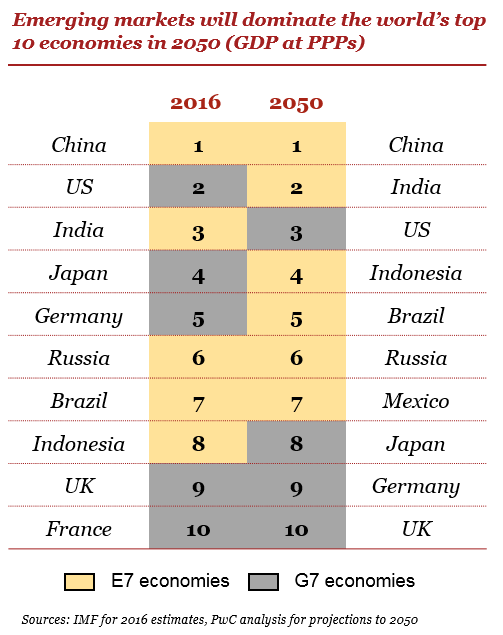
If the GDP projections of PwC are correct, not a single European country will sit at the table when the G8 gathers in 2050. Germany can still join the G8 in 2030, but not the country that is currently most absorbed by defending its sovereignty: the United Kingdom.

Source: PwC (2017)

Of course, projections like these should be taken with a substantial grain of salt. But it sends a crystal clear message to Europe: now is the time to make up your mind! What do you really want? Be the 4th giant in the world – next to China, India and the US – or settle for glorious dwarfness by prioritizing national sovereignty over European unity?

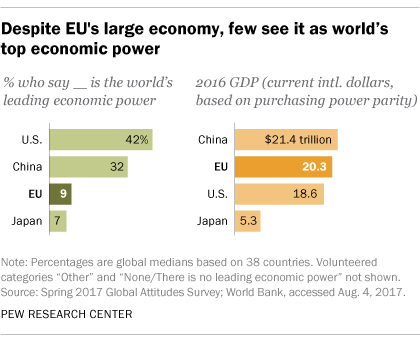
Economically, the EU is already a giant. It is the world’s second-largest economy by GDP. But as long as the EU doesn’t grow up as a political entity (with one democratically chosen leader speaking on behalf of all EU members and citizens), we will continue to see a mind-boggling contradiction t between the EU’s strength as economic power and weakness as political leader, illustrated by the survey below:

Source: Pew Research Center (2017)

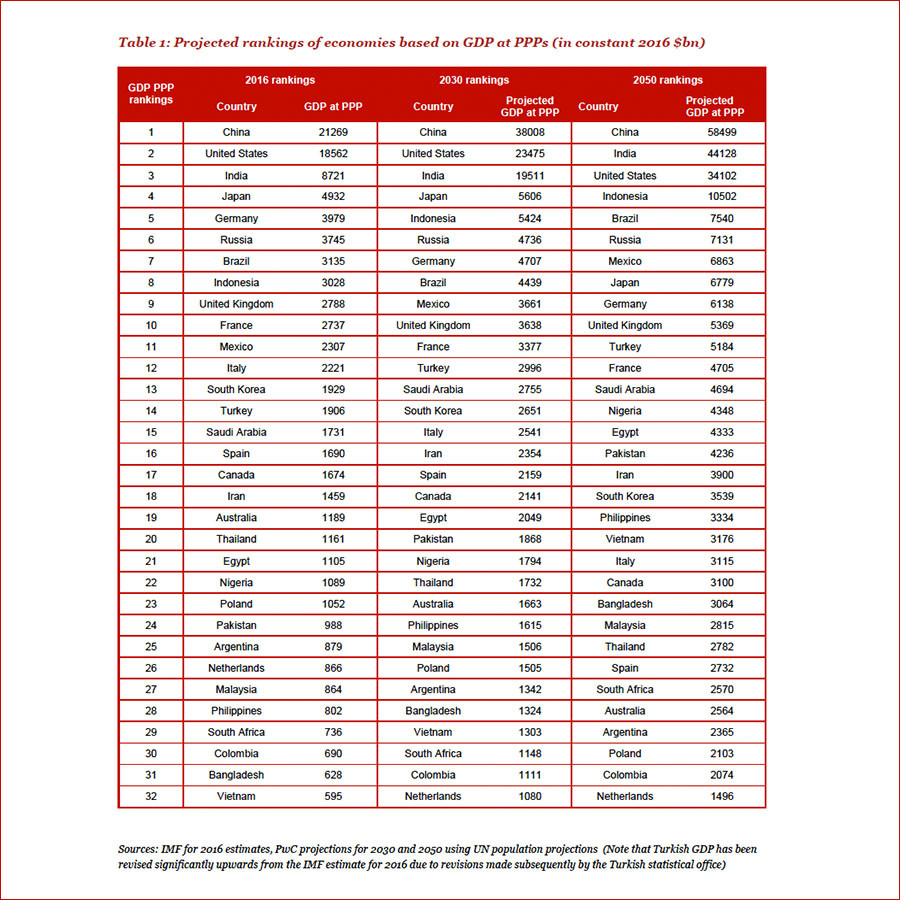
Below PwC’s ranking of the top-32 economies in 2016, 2030 en 2050. Europe is rapidly losing ground in the market place. Time to make up its mind. The current EU-approach is neither fish nor fowl, with for example a G20 containing both leaders of individual EU-countries and a representative of the EU. The more the rankings below become a reality, the more European countries will have to decide: splendid isolation as sovereign nations or significant participation as united EU.

Source: PwC (2017)

BACK TO BLOGS

18 of the last 20 centuries China and India were the biggest economies

Source: Michael Cembalest, Angus Maddison (2008), updated by Visual Capitalist

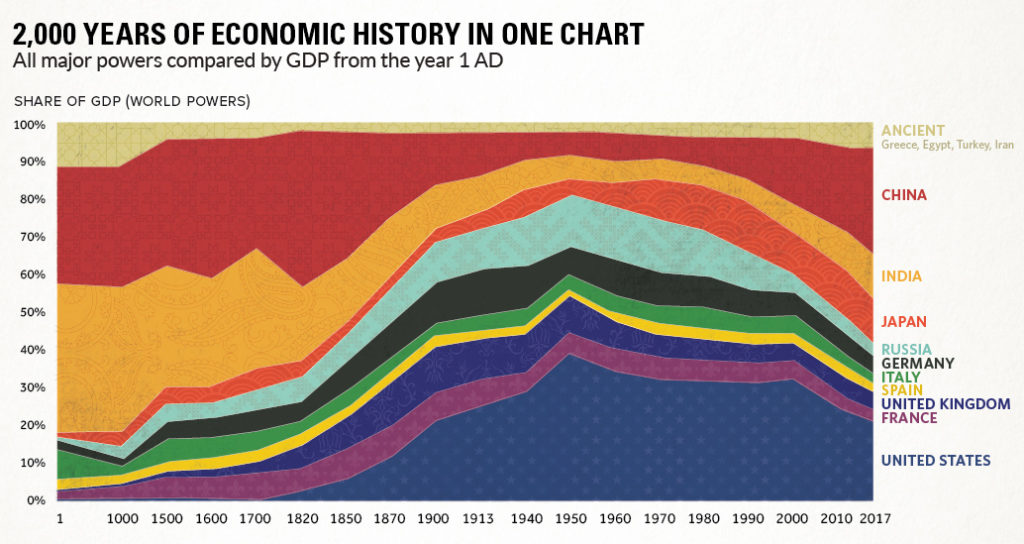
A quick look at the above chart and you may be surprised to see that China and India were by far the biggest economies in the first 18 of the last 20 centuries. Sure, it is all based on estimations and using different time intervals on the x-axis is actually not done. But nevertheless, we can draw some valuable insights from this chart.

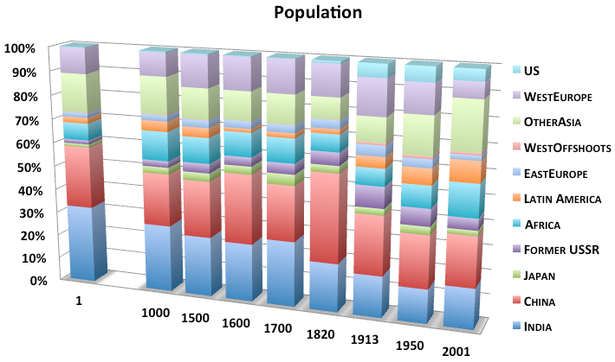
Until 1800, economic progress was largely linear and linked to population growth. The more people, the bigger the share of GDP in the global economy. Hence the leading position of China and India. Already 2000 years ago, 60% of the world’s population lived in these two countries (thanks to a growing amount of tea, cotton and rice).

Source: Derek Thompson (2012)

But then the Industrial Revolution changed the game altogether: suddenly, productivity started determining a country’s share of GDP in the world’s economy. Europe and the United States could produce way more wealth with their factories than the size of their population would indicate. It gave them a head start in economic power, which they unashamedly translated into military power. China and India faced severe humiliations from the West in the last 2 centuries.

But things are changing dramatically again. China and India are catching up, with China behaving like a petrol engine and India like a diesel engine (needing more time to warm up). The leverage of the West is diminishing, their head start disappearing. And this time, China and India can combine their industrial power with their immense population. Once both countries are ‘up to date’ and ‘up to scale’, their huge work force and internal market will allow them to go above and beyond. China may have reached this point already, India is on its way.

Once all of the catching up is done, we will see an economic world order that shouldn’t surprise anyone: a world order that existed already for 18 of the last 20 centuries and only got disrupted for 200 years.

BACK TO BLOGS